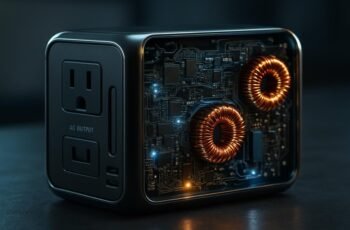
Did you know that over 40% of portable power station users prioritize wireless charging features? As we explore how inductive technology integrates into these devices, it’s clear this innovation goes beyond mere convenience. Understanding the technical benefits, compatibility factors, and efficiency impacts will help us evaluate whether wireless charging truly enhances portable power solutions or introduces new challenges. Let’s examine what makes this feature increasingly relevant in today’s charging landscape.
Key Takeaways
- Portable power stations use inductive coils to enable wireless charging for devices like smartphones and wearables without physical connectors.
- They support multiple devices simultaneously, streamlining charging and reducing cable clutter for enhanced user convenience.
- Effective thermal management in these stations preserves battery health and maintains charging efficiency during extended use.
- Compatibility with wireless standards like Qi ensures broad device support and safe energy transfer.
- Design factors include pad placement, portability, and anti-slip surfaces to optimize alignment and maximize charging performance.
How Wireless Charging Works in Portable Power Stations
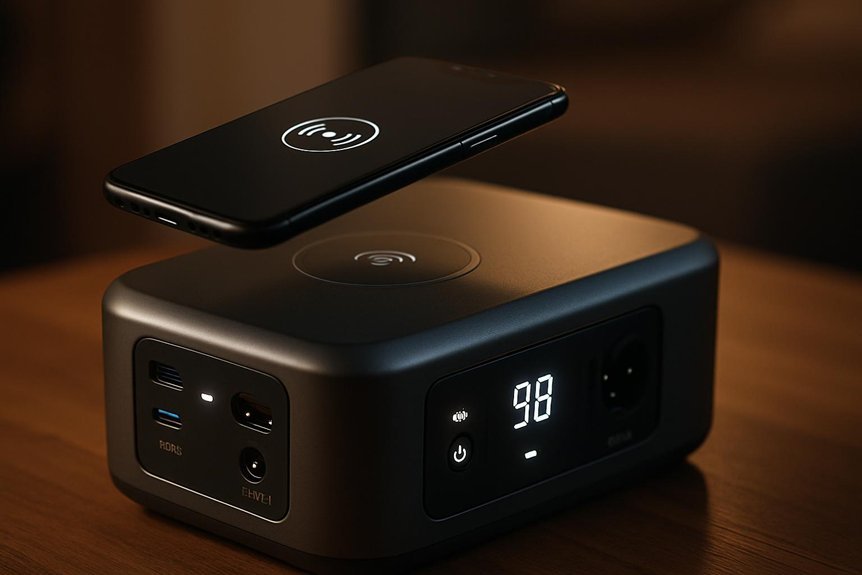
Although wireless charging might seem like a recent convenience, its integration into portable power stations relies on well-established electromagnetic principles. We use inductive technology, which involves creating a magnetic field between a transmitter coil in the power station and a receiver coil in the device. This magnetic coupling transfers energy efficiently without physical connectors. To guarantee compatibility and safety, portable power stations adhere to established charging standards, such as Qi or proprietary protocols, dictating power levels, communication, and coil alignment. These standards optimize energy transfer and reduce heat generation, preserving battery health. Understanding these mechanisms clarifies how wireless charging maintains performance and reliability, enabling seamless power delivery while minimizing wear on connectors and ports in portable power stations.
Key Benefits of Wireless Charging for Power Stations
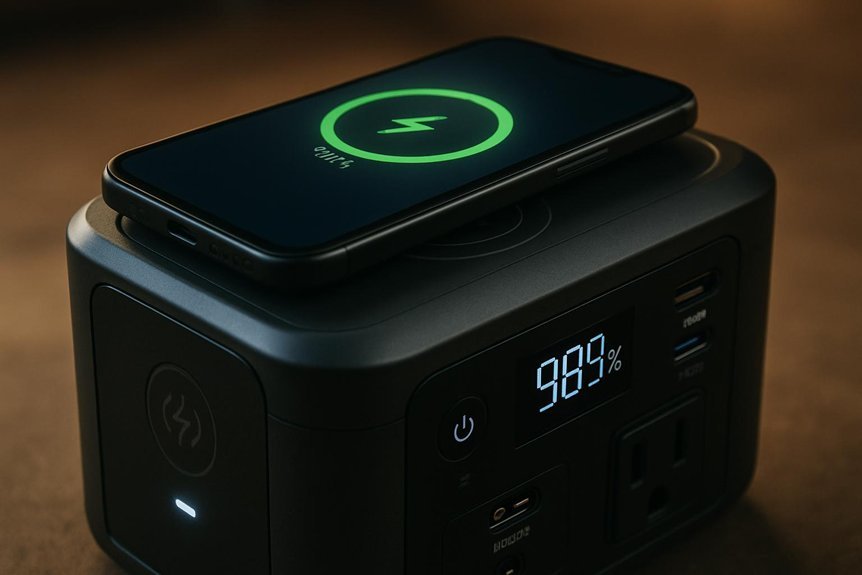
With a clear understanding of how wireless charging operates within portable power stations, we can now examine the specific advantages this technology offers. Wireless convenience eliminates the need for cables, reducing wear and tear on ports and connectors while streamlining the charging process. This charging innovation enhances user experience by enabling a clutter-free setup and quick device placement without alignment hassles. Additionally, wireless charging systems improve safety by minimizing exposed electrical contacts and reducing risks of short circuits or corrosion. From an engineering perspective, integrating wireless charging optimizes energy transfer efficiency and supports multi-device charging simultaneously. Collectively, these benefits position wireless charging as a transformative feature that elevates the functionality, durability, and user-friendliness of portable power stations, making them more adaptable for various charging scenarios.
Types of Devices You Can Charge Wirelessly

Anyone who uses portable power stations will appreciate the broad range of devices that support wireless charging. Primarily, smartphones and wearable devices, such as smartwatches and fitness trackers, are the most common targets due to their integrated Qi-compatible receivers. Tablets and e-readers, while less common, increasingly include wireless charging capabilities, enhancing portability. Gaming consoles with wireless controllers, Bluetooth speakers, and headphones also benefit, allowing seamless power without cable clutter. Additionally, cameras equipped with wireless charging pads streamline fieldwork, while drones with compatible batteries can recharge efficiently on the go. Even portable fans designed for outdoor use incorporate wireless charging for convenience. Understanding this device spectrum clarifies the versatility of wireless power stations, enabling users to optimize their charging strategies across multiple electronics efficiently.
What to Look for When Choosing a Wireless Power Station
When selecting a wireless power station, we must analyze several critical factors to guarantee it meets our charging needs efficiently. We need to evaluate supported wireless standards to assure compatibility with various devices. The number and placement of charging pads affect simultaneous device charging. Power management features optimize energy use and safety. User preferences, such as portability and design aesthetics, also influence our choice. Additionally, examining environmental impact and staying informed on technological advancements and market trends secures a future-proof investment.
| Factor | Key Consideration |
|---|---|
| Wireless Standards | Compatibility with Qi, AirFuel |
| Charging Pads | Quantity, size, placement |
| Power Management | Efficiency, safety, energy saving |
How Wireless Charging Affects Battery Life and Efficiency
After evaluating the key features of wireless power stations, we must consider how wireless charging impacts battery longevity and overall efficiency. Wireless charging introduces unique variables influencing battery degradation compared to wired methods. Key factors include:
- Charging Protocols: Advanced protocols optimize current flow, reducing stress on battery cells and mitigating degradation.
- Thermal Management: Wireless charging typically generates more heat, accelerating battery wear unless efficient cooling systems are integrated.
- Power Conversion Efficiency: Energy loss during inductive transfer can lower overall efficiency, requiring more frequent cycles that influence battery lifespan.
Comparing Wireless Charging Speeds in Portable Power Stations
Let’s analyze wireless charging speeds by examining key metrics like power output and charge time across various portable power stations. We’ll also consider how device compatibility influences these speeds, as mismatched standards can reduce efficiency. Finally, we’ll evaluate the trade-offs between charging speed and overall energy efficiency to identify ideal performance.
Charging Speed Metrics
Although wireless charging offers convenience, evaluating its efficiency requires a detailed examination of charging speed metrics in portable power stations. To accurately assess performance, we need to focus on key factors influencing charging rates:
- Charging Protocols: Different protocols like Qi and proprietary standards impact power transfer efficiency and speed, affecting overall charge times.
- Power Output Levels: Wattage ratings determine maximum charging speed; higher outputs generally yield faster charging but may vary by device compatibility.
- Thermal Management: Effective heat dissipation prevents throttling, maintaining consistent charging speeds during prolonged use.
Device Compatibility Impact
When we compare wireless charging speeds in portable power stations, device compatibility plays a crucial role in determining performance outcomes. Different devices support varying charging standards, affecting the speed and efficiency of power transfer. A mismatch in compatibility can reduce charging rates and degrade the overall user experience.
| Device Type | Supported Standard | Max Wireless Charging Speed (W) |
|---|---|---|
| Smartphone A | Qi 1.2 | 10 |
| Smartphone B | Qi 1.3 | 15 |
| Tablet C | Proprietary | 7 |
| Smartwatch D | Qi 1.0 | 5 |
| Earbuds E | Qi 1.2 | 3.5 |
Understanding these differences helps us select power stations that optimize charging speeds and improve user experience through better device compatibility.
Efficiency vs Power Output
Since wireless charging efficiency directly influences power output, analyzing their relationship is essential for evaluating portable power stations. Power efficiency determines how effectively energy transfers from the station to the device, impacting overall charging speed and heat generation. When we perform an output comparison, three critical factors emerge:
- Transmission Distance: Greater distances reduce power efficiency, lowering effective output.
- Coil Alignment: Misalignment causes energy loss, diminishing output despite nominal power ratings.
- Heat Dissipation: Excess heat reduces efficiency, throttling power output to protect components.
Portability and Design Features That Enhance Wireless Charging
As we evaluate portable power stations, we must consider how their design directly influences the efficiency and convenience of wireless charging. A compact design paired with lightweight construction enhances portability without compromising power capacity. Ergonomic features guarantee ease of handling, while durable materials protect internal components from physical stress. Effective heat management is critical; it prevents thermal throttling during simultaneous multi-device capability, maintaining consistent charging speeds. A user-friendly interface simplifies operation, allowing quick access to wireless charging functions. Additionally, aesthetic appeal plays a role in user satisfaction, encouraging regular use. By integrating these design elements, portable power stations can optimize wireless charging performance while remaining practical for on-the-go applications, striking a balance between form, function, and durability.
Common Challenges With Wireless Charging and How to Avoid Them
We need to address key challenges like alignment and positioning issues that reduce charging effectiveness. Interference and signal blockage also disrupt power transfer, while inherent power efficiency limitations impact overall performance. By understanding these factors, we can implement strategies to optimize wireless charging in portable power stations.
Alignment and Positioning Issues
Although wireless charging offers convenience, alignment and positioning issues frequently undermine its efficiency in portable power stations. To enhance power transfer, we need to focus on precise alignment techniques and effective positioning tips. Misalignment reduces coupling efficiency, leading to slower charging or power loss. Here are three critical considerations:
- Coil Alignment: Confirm the charging coils in the power station and device are concentrically aligned. Even slight lateral shifts can drastically decrease energy transfer.
- Vertical Distance: Maintain an ideal gap between coils, usually within a few millimeters, to maximize magnetic field strength and efficiency.
- Stable Placement: Use positioning tips such as anti-slip surfaces or guides to prevent displacement during charging, confirming consistent coil alignment throughout the process.
Interference and Signal Blockage
Misalignment challenges often give way to another significant obstacle in wireless charging: interference and signal blockage. Various interference sources, such as metallic objects, electronic devices, and environmental factors, degrade signal strength, reducing charging efficiency. To maintain peak performance, we must understand and mitigate these signal disruptions.
| Interference Source | Impact on Signal Strength |
|---|---|
| Metallic Objects | Causes reflection and absorption, weakening signal |
| Electronic Devices | Emits electromagnetic noise, disrupting communication |
| Physical Obstacles | Blocks or scatters the wireless signal path |
| Environmental Factors | Temperature and humidity affect signal propagation |
Power Efficiency Limitations
Since wireless charging relies heavily on efficient energy transfer, power efficiency limitations present a critical challenge in portable power stations. We must address efficiency trade offs and minimize energy loss to optimize performance. Several factors contribute to these limitations:
- Coil Alignment: Misalignment between transmitter and receiver coils increases energy loss, reducing transfer efficiency.
- Distance Constraints: Efficiency sharply decreases as the gap widens, forcing design compromises between convenience and power delivery.
- Thermal Dissipation: Excess heat generated during charging causes additional energy loss, impacting both safety and efficiency.
Understanding these constraints helps us innovate better coil designs, optimize placement, and improve thermal management. By focusing on these areas, we can mitigate power efficiency limitations and enhance the practicality of wireless charging in portable power stations.
Future Trends in Wireless Charging for Portable Power Stations
As we look ahead, wireless charging technology for portable power stations is set to evolve rapidly, driven by advances in efficiency, power transfer range, and integration with smart systems. Future technologies will emphasize higher power densities and adaptive alignment to enhance user experiences while addressing integration challenges with diverse device architectures. Market predictions indicate increased adoption influenced by shifting consumer preferences toward convenience and sustainability. Industry innovations focus on minimizing environmental impacts through improved materials and energy management protocols. The competitive landscape is intensifying, prompting design advancements that balance portability with regulatory considerations such as safety and electromagnetic compliance. To succeed, manufacturers must navigate complex standards while delivering seamless, efficient charging solutions. This convergence of factors will shape the next generation of wireless charging in portable power stations.
Frequently Asked Questions
Are Wireless Charging Portable Power Stations Safe for Children?
We believe wireless charging portable power stations are generally safe for children if designed with proper child safety features. However, understanding the charging technology and supervising usage guarantees minimizing risks associated with electromagnetic exposure or device handling.
Can Wireless Charging Cause Interference With Medical Devices?
We’ve seen how a radio’s static disrupts a calm conversation—similarly, wireless charging safety demands rigorous medical device compatibility testing. While rare, interference can occur, so we must guarantee devices meet strict standards to protect users reliably.
What Is the Environmental Impact of Wireless Charging Technology?
We recognize that wireless charging’s energy efficiency is typically lower than wired methods, raising sustainability concerns. However, ongoing advancements aim to minimize energy loss, improving environmental impact while supporting broader adoption of greener, more convenient charging solutions.
How Do Wireless Power Stations Perform in Extreme Weather Conditions?
We face storms and blizzards head-on! Performance factors like temperature tolerance and humidity resistance define weather resilience. Our rigorous testing guarantees these power stations maintain efficiency and durability, even in the harshest extreme weather conditions.
Are There Any Warranty Differences for Wireless Charging Models?
We’ve noticed warranty coverage can vary between model variations, especially with wireless charging features. It’s essential to analyze specific terms carefully, as some manufacturers offer limited coverage on wireless components, impacting overall protection.
Conclusion
Just as a well-oiled machine hums smoothly without friction, wireless charging in portable power stations streamlines our energy needs by removing physical barriers. By embracing this technology, we’re not just cutting cords—we’re engineering a seamless flow of power that adapts to our mobile lifestyle. Like circuits closing effortlessly, wireless charging connects efficiency, convenience, and innovation, empowering us to stay charged and ready without the wear and tear of traditional connections.