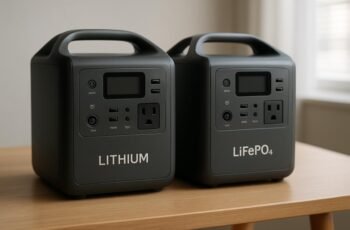
When choosing between a portable power station and a power bank, we need to carefully consider their core differences in capacity, output options, and intended use. Power banks excel at charging smaller devices on the go, while portable power stations are designed for higher energy demands and versatile applications. Understanding these distinctions will help us determine which solution aligns best with our specific power needs and lifestyle. But how exactly do these differences impact performance and practicality?
Key Takeaways
- Power banks are compact and designed for charging small devices like smartphones, while portable power stations support larger devices and multiple outputs, including AC outlets.
- Battery capacity in portable power stations is significantly higher, enabling longer usage for laptops, mini-fridges, and multiple devices simultaneously.
- Portable power stations are heavier and bulkier, suitable for outdoor activities, whereas power banks prioritize portability for everyday use.
- Power stations offer diverse input options (AC, DC, solar) and faster charging speeds compared to power banks’ typical USB-C or Micro-USB inputs.
- Despite higher costs, portable power stations provide greater durability, multiple ports, and long-term investment value versus the affordable, compact power banks.
What’s the Main Difference Between Portable Power Stations and Power Banks?
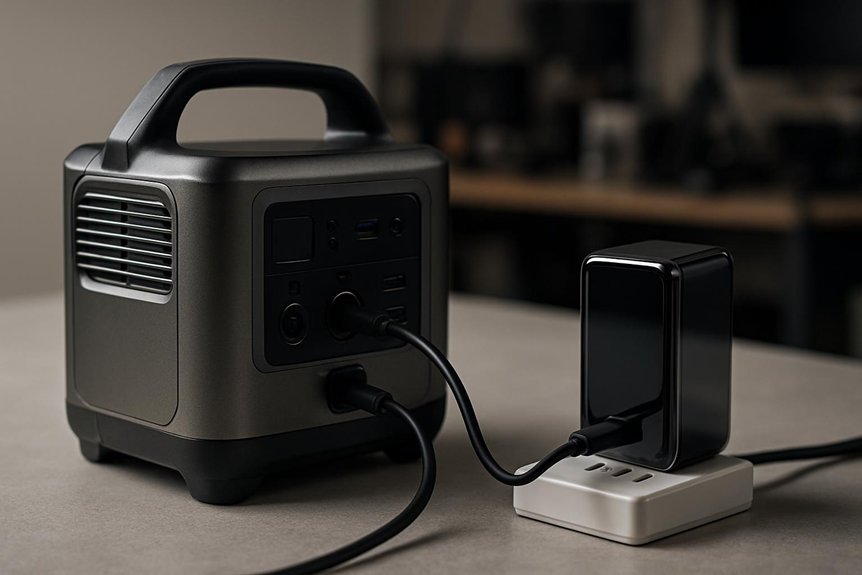
Although both portable power stations and power banks serve to recharge devices on the go, they differ considerably in capacity, output, and intended use. Power banks typically cater to low power requirements, designed primarily for charging smartphones, tablets, and small electronics. Their compact form suits everyday usage scenarios like commuting or short trips. In contrast, portable power stations handle higher power demands, supporting larger devices such as laptops, mini-fridges, or even medical equipment. They often feature multiple output types, including AC outlets, to accommodate diverse devices. Understanding these differences is essential for selecting the appropriate device based on expected power requirements and usage scenarios. While both offer portability, power stations deliver more robust, versatile energy solutions, whereas power banks prioritize convenience and light-duty charging.
How Battery Capacity Affects What You Can Power
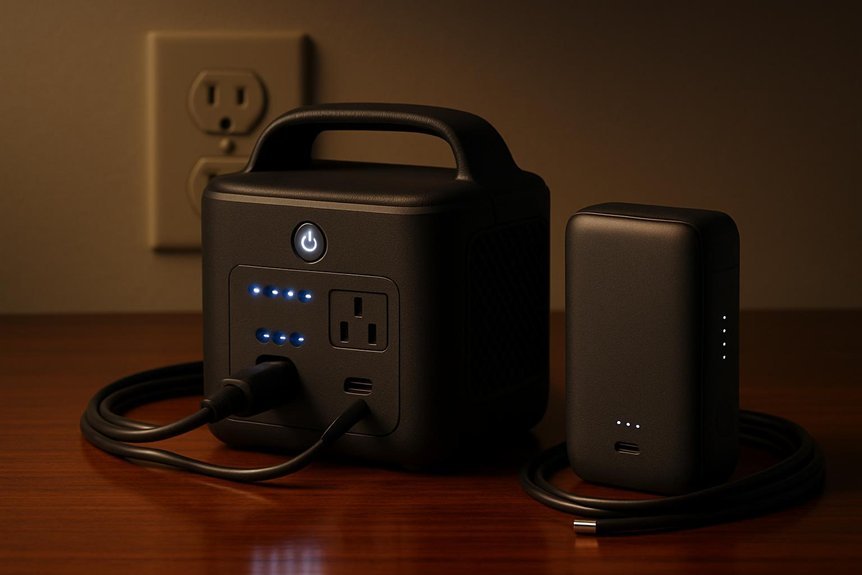
Battery capacity directly determines the range and duration of devices we can power with portable energy solutions. By analyzing capacity ratings, measured in watt-hours (Wh) or milliamp-hours (mAh), we assess how long a power source can sustain a device’s energy demands. Battery chemistry plays an essential role here, influencing energy density and discharge rates, which affect usable capacity and efficiency. For example, lithium-ion batteries typically offer higher capacity ratings and better energy retention compared to lead-acid alternatives. This means portable power stations, often equipped with advanced battery chemistries and higher capacity ratings, can support larger or multiple devices longer than typical power banks. Understanding these technical distinctions helps us select the right portable power solution based on the specific load and desired runtime.
Comparing Size and Portability for Everyday Use
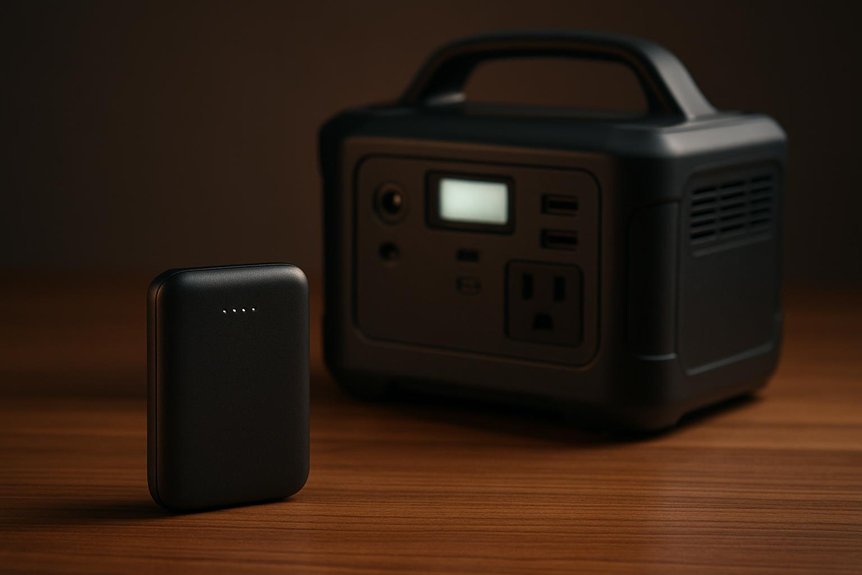
When we evaluate portable power solutions, size and portability become critical factors that influence daily usability and convenience. Power banks typically feature a compact design, making them lightweight and easy to carry in pockets or small bags. This enhances everyday convenience, especially for charging smartphones or small devices on the go. In contrast, portable power stations are larger and heavier due to higher capacity batteries and multiple output options. While this reduces their pocketability, power stations remain portable enough for car trips or outdoor activities where bulkier equipment is manageable. Consequently, the choice between these devices hinges on balancing compact design against power needs. For daily carry, power banks excel in portability, whereas power stations are suited for scenarios demanding more power despite reduced mobility.
Which Devices Each Option Can Charge or Run
Since our power needs vary widely depending on the devices we use, understanding which devices each option can charge or run is essential. Portable power stations handle high-capacity devices like laptops and camping gear efficiently, while power banks cater primarily to smaller electronics such as smartphones and tablets.
| Device Type | Portable Power Station | Power Bank |
|---|---|---|
| Laptop | Yes, supports laptop charging | Limited, often insufficient |
| Camping Gear | Can power LED lights, fans | Rarely suitable |
| Smartphones | Yes, multiple charges possible | Optimized for smartphones |
| Small Electronics | Supports various USB devices | Best for low-power devices |
Analyzing device compatibility helps us select the right power source tailored to our specific needs.
Understanding Charging Speed and Input Options
Let’s examine how charging speeds vary between portable power stations and power banks, focusing on their input port types and power source compatibility. Understanding these factors is essential for optimizing recharge times and ensuring reliable operation in different scenarios. We’ll analyze the technical specifications that influence performance and versatility in real-world use.
Charging Speed Comparison
How quickly can we recharge our devices, and what factors influence that speed? Charging speed depends primarily on the power output and the charging methods employed. Power banks typically offer lower power outputs, often around 10-20W, suitable for small devices like smartphones. Portable power stations, however, can deliver considerably higher wattages—sometimes exceeding 100W—allowing faster recharge times for larger electronics. Additionally, the compatibility between the device’s charging protocol and the power source affects efficiency. While both use USB or DC output methods, advanced power stations support fast-charging standards like USB Power Delivery, which optimizes voltage and current for quicker charging. Understanding these differences helps us choose the right solution based on our device’s power requirements and desired recharge speed.
Input Port Varieties
Beyond output capabilities, the types and number of input ports on portable power stations and power banks directly influence how quickly and conveniently we can recharge the power sources themselves. Different input types affect charging speed and port compatibility with chargers or solar panels. Portable power stations typically feature multiple input options—like AC, DC, and solar inputs—enabling versatile recharging methods. Power banks, however, generally rely on USB-C or Micro-USB inputs, limiting their charging sources but often supporting fast charging protocols.
| Device Type | Common Input Types | Port Compatibility |
|---|---|---|
| Portable Power Station | AC, DC, Solar | Broad (wall, car, solar panel) |
| Power Bank | USB-C, Micro-USB | Limited (wall adapters, USB chargers) |
Understanding these input port varieties helps optimize recharge efficiency and compatibility.
Power Source Compatibility
While charging speed largely depends on the power source’s output capabilities, the compatibility between the power source and the device’s input options plays an equally critical role. Understanding this interaction helps improve charging efficiency and flexibility, especially when comparing portable power stations and power banks.
- Solar Compatibility: Portable power stations often support direct solar panel input, enabling off-grid charging, unlike most power banks.
- Outlet Options: Multiple input outlets—such as AC, USB-C PD, and DC—enhance a power station’s adaptability to various power sources.
- Input Voltage Range: Matching the input voltage range between the charger and power source prevents inefficiencies or damage.
- Charging Protocol Support: Devices supporting fast-charging protocols (e.g., QC, PD) guarantee maximum power transfer within compatible setups.
Recognizing these factors guarantees we select the best power source-device pairing for peak performance.
Price Differences and Value for Your Needs
Let’s compare the cost structures of portable power stations and power banks to understand which offers better value based on your requirements. We’ll analyze features relative to their price points to identify where each device justifies its expense. Finally, we’ll evaluate their long-term investment potential by considering durability and capacity over time.
Cost Comparison Overview
When comparing the costs of portable power stations and power banks, we find distinct price ranges that reflect their capacities and functionalities. For effective budget planning, understanding these differences enhances cost effectiveness.
- Power banks typically range from $20 to $150, ideal for charging small devices.
- Portable power stations start around $200 and can exceed $1,500, accommodating larger power needs.
- Cost scales with battery capacity, output power, and additional features like multiple ports or solar compatibility.
- Evaluating your power requirements against these price points guarantees an ideal investment without overspending.
Features Versus Price
Balancing features against price demands a careful analysis of what each device offers relative to its cost. In our features comparison, portable power stations provide higher capacity, multiple output ports, and often include AC outlets, which justify their elevated price point. Conversely, power banks focus on compactness and portability, offering USB outputs suited for smaller devices at a lower price. Our price analysis reveals that while portable power stations require a significant upfront investment, they deliver broader functionality for complex power needs. Power banks, being more affordable, serve well for basic charging tasks but lack the versatility of power stations. Ultimately, evaluating your power requirements against these features and their associated prices guarantees you select a device that aligns with both your budget and operational demands.
Long-Term Investment Value
Understanding long-term investment value involves analyzing how price differences between portable power stations and power banks translate into practical benefits over time. When evaluating investment longevity and future proofing technology, consider these factors:
- Capacity vs Cost: Portable power stations offer higher capacity, justifying their higher initial price through longer usage and fewer replacements.
- Durability: Power stations generally incorporate robust components designed for extended life cycles, enhancing investment longevity.
- Technological Upgradability: Some power stations support firmware updates and modular enhancements, ensuring future proofing technology.
- Use Case Efficiency: Matching device outputs with your needs maximizes return on investment, avoiding overspending on unnecessary capacity.
Frequently Asked Questions
Are Portable Power Stations Safe to Use Indoors?
Yes, we find portable power stations safe for indoor usage when they include robust safety features like overcharge protection, short-circuit prevention, and proper ventilation, ensuring stable operation and minimizing risks during extended indoor use.
How Do Temperature Extremes Affect Battery Performance?
We understand battery chemistry significantly affects performance across temperature ranges; extreme cold slows chemical reactions, reducing capacity, while excessive heat accelerates degradation. We must monitor and operate batteries within ideal temperature ranges to maintain efficiency and longevity.
Can Power Banks Be Used to Jump-Start a Car?
Let’s cut to the chase: most power banks can’t handle car jump starting because their power bank specifications lack the high current output needed. Only specialized power banks designed for car jump starting work safely and effectively.
What Maintenance Is Required for Long-Term Battery Health?
We should monitor charging cycles closely and avoid full discharges to extend battery lifespan. Regularly storing batteries at 40-60% charge prevents degradation, while keeping them cool and dry helps maintain peak performance over time.
Are There Environmental Concerns With Disposing of These Batteries?
Yes, improper disposal increases environmental impact due to toxic materials. We must prioritize battery recycling to recover valuable components, reduce pollution, and guarantee sustainable resource use, minimizing ecological harm from both portable power stations and power banks.
Conclusion
In conclusion, choosing between a portable power station and a power bank boils down to your specific energy needs. Power banks excel at keeping small devices charged on the go, while portable power stations are the heavy lifters, powering larger electronics with ease. Think of power banks as nimble sprinters and power stations as steady marathoners—each designed for different terrains. By understanding capacity, portability, and device compatibility, we can make an informed decision that truly fits our lifestyle.