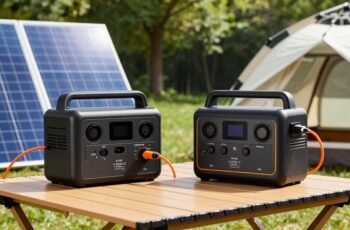
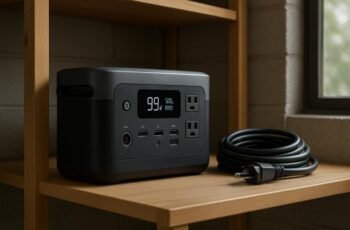
Charging a power station is like filling a reservoir—timing depends on multiple precise factors. We need to consider capacity, charging method, and environmental conditions to determine how long it takes to reach full capacity. Understanding these variables is essential for optimizing efficiency and safety. As we explore the intricacies of charging duration, you’ll find that knowing the right approach can substantially influence performance and longevity. Let’s examine what impacts these times and how to manage them effectively.
Key Takeaways
- Charging time depends on the power station’s battery capacity (Wh) and the input wattage of the charger or station.
- Typical charging durations range from 2 to 20 hours, depending on battery size and charging method.
- Using higher wattage inputs (e.g., fast chargers) reduces charging time but may impact battery longevity.
- Charging via wall outlets is faster than car or solar panel charging, which are slower.
- Proper charging practices and temperature management help ensure full charge efficiency and battery health.
How Long Does It Usually Take to Fully Charge a Power Station?
How long does it usually take to fully charge a power station? The charging duration depends primarily on the battery capacity, measured in watt-hours (Wh), and the charging power output, typically specified in watts (W). For example, a 1,000 Wh capacity charged at 100 W will take approximately 10 hours. Charging efficiency factors, such as cable quality and power source stability, also influence total time. Most commercial power stations support input charging rates ranging from 50 W to 200 W, affecting recharge times proportionally. Additionally, built-in charging protocols and safety features can introduce brief delays. In general, a standard power station with a 500 Wh capacity, charged at 100 W, requires around five hours for a full recharge, assuming ideal conditions.
Factors That Affect Charging Time for Power Stations
Charging time for power stations is primarily influenced by battery capacity, with larger capacities requiring more time. Variations in charging methods and the quality of the power source also considerably affect the rate at which a station can be replenished. Understanding these factors allows for more accurate estimations of overall charging duration.
Battery Capacity Impact
The capacity of a power station’s battery plays a critical role in determining its charging time, as larger batteries require more energy to reach full capacity. This direct relationship means that a 200Wh battery will charge faster than a 2000Wh model, assuming identical charging conditions. The table below illustrates how capacity influences charging duration at a constant charging rate:
| Battery Capacity | Approximate Charging Time | Power Input Needed |
|---|---|---|
| 200Wh | 1-2 hours | 100W |
| 500Wh | 2.5-5 hours | 100W |
| 1000Wh | 5-10 hours | 100W |
| 2000Wh | 10-20 hours | 100W |
Larger capacities demand proportionally more time, emphasizing the importance of capacity considerations in planning charging routines.
Charging Method Variations
Different charging methods markedly influence how quickly a power station reaches full capacity. Fast charging techniques, such as high-current AC or DC fast chargers, notably reduce charging times but may generate more heat and accelerate battery degradation over time. Conversely, standard AC charging provides a lower current, resulting in a longer, more gradual charge cycle that preserves battery health. The implementation of smart charging protocols, which optimize current flow based on battery status and temperature, further affects charging speed and efficiency. Additionally, the use of dedicated charging ports with varying power ratings can alter the overall time required to reach full capacity. Understanding these variations allows us to select appropriate charging methods that balance speed, safety, and long-term battery performance.
Power Source Quality
The quality of the power source plays a critical role in determining how quickly a power station can be fully charged. Higher-quality sources provide stable voltage and current, reducing charging times and preventing damage. Conversely, inconsistent or poor-quality sources can cause fluctuations, slowing the process or risking equipment safety. Charging efficiency depends on the power source’s voltage stability, power output capacity, and overall reliability.
| Power Source Quality | Impact on Charging Time | Potential Risks |
|---|---|---|
| High-quality (stable) | Faster, consistent | Minimal, safe |
| Medium-quality | Moderate, variable | Possible damage |
| Low-quality (unstable) | Slower, inconsistent | Damage, safety issues |
Choosing a stable, high-quality source optimizes charging speed and longevity.
Comparing Charging Methods: Wall Outlet, Car, and Solar Panel
Charging methods for power stations vary considerably in terms of speed, convenience, and energy source. Using a wall outlet typically provides the fastest charging due to high current output, often reaching full capacity within a few hours depending on the charger’s power rating. Car charging utilizes a standard 12V socket, which supplies lower current, resulting in longer charging times—potentially doubling or tripling wall outlet durations. Solar panel charging depends on panel wattage and sunlight conditions; it’s the most sustainable but usually the slowest, often requiring several hours or days for a full charge. Each method’s efficiency hinges on the power station’s input specifications, with wall outlets offering the most rapid recharge, followed by vehicle adapters, and finally solar panels, which prioritize sustainability over speed.
How Capacity and Charger Power Output Influence Charging Speed
Since the capacity of a power station determines the total energy it can store, it directly impacts how long it takes to fully charge the device. Larger capacities require more energy transfer, extending charging times if the charger’s power output remains constant. Conversely, a higher charger power output can substantially reduce charging duration by delivering energy at a faster rate. The relationship between capacity and charger power is governed by the power transfer rate, measured in watts (W), which influences how quickly the storage is replenished. To optimize charging speed, it’s essential to match the power output with the device’s maximum input rate. An imbalance—either low charger power or excessive capacity—can prolong charge times, emphasizing the importance of compatible specifications for efficient charging.
Tips to Speed Up the Charging Process
Optimizing the charging process involves practical adjustments that can greatly reduce total time. First, make sure you use the maximum rated input power compatible with your power station, as higher input wattage accelerates charging. Avoid using multiple devices simultaneously on the same circuit, which can cause voltage drops and reduce charging efficiency. Keep the power station in a cool, well-ventilated environment; elevated temperatures slow chemical processes within the cells, prolonging charge times. Use high-quality, compatible charging cables and connectors to minimize resistance and voltage drops. Additionally, enabling fast-charging modes, if available, can markedly reduce charging duration. Regularly update the device’s firmware, as manufacturers often optimize charging algorithms through updates, enhancing overall speed and efficiency.
How to Estimate When Your Power Station Will Be Fully Charged
To accurately estimate when your power station will be fully charged, we need to take into account several key variables: the current battery level, the input power rate, and the battery’s total capacity. First, determine the remaining capacity by subtracting the current state of charge from the total capacity. Next, identify the input power rate in watts, which indicates how quickly energy is being transferred during charging. Divide the remaining capacity (in watt-hours) by the input power rate to calculate the approximate time remaining in hours. Keep in mind that charging rates can fluctuate due to temperature, cable quality, and power source stability. Precise estimation requires monitoring these variables and understanding that real-time factors may slightly alter the predicted charging duration.
Common Charging Mistakes That Delay Full Recharge
Charging a power station correctly is essential for maximizing battery life and guaranteeing efficient recharging. Common mistakes can considerably delay reaching a full charge.
Proper charging practices extend battery life and ensure efficient, full recharges.
- Using incompatible chargers — Mismatched voltage or current can slow charging or damage the battery.
- Interrupting the charge cycle — Disconnecting prematurely prevents the battery from reaching ideal capacity.
- Charging at extreme temperatures — Cold or hot environments impair chemical reactions, hindering full recharge.
- Overcharging beyond the recommended level — Continuously charging past 100% can cause battery stress and reduce lifespan.
Avoiding these errors ensures a more efficient, faster recharge process and prolongs the overall health of the power station’s battery. Precision in charging practices directly influences how quickly and effectively your device reaches full capacity.
How to Maintain Your Power Station’s Battery Health During Charging
Maintaining your power station’s battery health during charging requires careful attention to operational conditions and charging practices. Proper charging involves avoiding overcharging and ensuring the temperature remains within recommended limits. Use chargers compatible with your power station to prevent voltage stress. Regularly monitor voltage and current levels during charging, and disconnect once fully charged to prevent capacity degradation. Implementing proper charging cycles extends battery longevity and preserves capacity.
| Charging Practice | Recommended Action | Impact |
|---|---|---|
| Avoid Overcharging | Unplug when fully charged | Prevents capacity loss |
| Monitor Temperature | Keep within 0°C–45°C | Preserves battery chemistry |
| Use Compatible Chargers | Employ original or certified chargers | Ensures safe, efficient charge |
| Limit Deep Discharges | Recharge before voltage drops too low | Extends overall lifespan |
| Maintain Proper Storage | Store in a cool, dry place when idle | Prevents capacity degradation |
Frequently Asked Questions
Can I Leave My Power Station Charging Overnight Safely?
Yes, you can leave your power station charging overnight safely if it has built-in overcharge protection and is used with the correct charger. Always monitor for overheating or unusual behavior, and follow manufacturer guidelines for safe operation.
Does Temperature Affect Charging Speed for Power Stations?
Yes, temperature affects charging speed; higher temperatures can accelerate charging but risk overheating, while lower temperatures slow the process. We recommend charging within the specified temperature range to optimize efficiency and guarantee safety during the process.
Is It Okay to Charge a Power Station With Multiple Sources Simultaneously?
Charging a power station with multiple sources simultaneously can be safe if the device supports multi-input charging. We recommend consulting the manufacturer’s specifications to prevent overloading, guarantee compatibility, and optimize charging efficiency without risking damage.
How Often Should I Fully Recharge My Power Station?
We recommend fully recharging your power station at least once every three months to maintain ideal battery health and longevity. Regular full cycles prevent capacity loss and guarantee dependable performance during critical power needs.
Do Power Stations Have a Maximum Charging Time Limit?
Power stations generally lack a strict maximum charging time, but most manufacturers recommend not exceeding 24 hours to prevent battery degradation; continuous charging beyond this can lead to reduced capacity and lifespan, emphasizing the importance of adhering to specific guidelines.
Conclusion
In summary, understanding the factors influencing charging times helps us optimize our power stations effectively. Did you know that a typical 500 Wh power station charged at 100 W takes about 5 hours, but using fast chargers can cut this time considerably? Proper charging practices guarantee safety, efficiency, and longevity of your battery. By monitoring capacity, charger output, and environmental conditions, we can guarantee reliable, full recharges every time, maximizing our power station’s lifespan and performance.