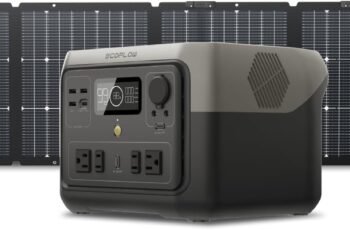
We’ll assess the ANTPO 500W Portable Power Station by looking at its fuel-can-inspired design, 512Wh LiFePO4 battery, 500W pure sine wave output, and range of charging ports. At 13.2 pounds, it’s built for portable use, but its power limits matter when choosing appliances for camping, RV trips, or backup. We’ll also weigh its charging speed and practical trade-offs to see where it fits—and where it falls short.
Key Takeaways
- The ANTPO 500W packs a 512Wh LiFePO4 battery and 500W pure sine wave inverter, with 1,000W surge capacity.
- Its 13.2-pound fuel-can design, integrated handle, and LCD make it portable and easy to monitor.
- Outputs include AC, car, USB-C PD 60W, and QC3.0, supporting up to eight devices within the station’s limits.
- Wall charging reaches 80% in one hour; optional solar charging takes eight to nine hours and depends on conditions.
- It suits camping, RV trips, and outages, but its 500W output and 512Wh capacity limit high-demand or extended use.
Retro Fuel-Can Design
With its retro fuel-can silhouette, the ANTPO 500W stands out from conventional box-shaped power stations. Its Rugged styling gives the enclosure a purposeful, equipment-inspired appearance, while the compact silhouette helps it fit more easily into a vehicle, RV, or camping setup. At 13.2 pounds, it’s portable enough for us to move between a campsite, tailgate, or boat without treating it as lightweight gear. The integrated easy-grip handle provides a direct hold when we lift and reposition the unit. This design balances distinctive form with practical transport, though its shape differs from the flat-sided cases common among portable power stations.
Detailed features
Beyond its fuel-can styling, the ANTPO 500W’s specifications define what it can run and how quickly it can recharge. Its 512Wh Grade-A LiFePO4 battery feeds a 500W continuous, 1,000W surge pure sine wave inverter, supporting up to eight devices through 110V AC, car, PD 60W, and QC3.0 outputs. A battery management system protects against temperature extremes, short circuits, and over-voltage. The LCD reports output wattage, charge percentage, and estimated runtime. For charging options, we can use a 500W wall outlet to reach 80% in one hour, a 200W solar panel in eight to nine hours, or a 12V car outlet.
Pros and Cons
We’ll weigh the ANTPO’s 500W output, 512Wh LiFePO4 battery, rapid AC charging, and 13.2 lb portability against its practical limitations. Its 1,000W surge capacity and multiple outputs support varied devices, but they don’t make it suitable for every high-wattage load. Let’s examine the key pros and cons so you can judge whether it fits your needs.
Pros
A key advantage of the ANTPO 500W is its 512Wh LiFePO4 battery, rated for more than 3,500 charge cycles, paired with a 500W pure sine wave inverter that can handle devices such as laptops, CPAP machines, and mini-fridges within its power limits. We get versatile charging through AC, car, PD 60W, and QC3.0 outputs, with capacity for up to eight devices. The 1,000W surge rating accommodates brief startup demands, while the LCD reports wattage, charge level, and estimated runtime. Its 13.2-pound body and integrated handle support transport. Fast wall charging, solar input, and a 24-month warranty add practical value.
Cons
Although the ANTPO offers useful portability, its 500W continuous output limits which appliances and power tools it can run, and the 512Wh capacity may require frequent recharging during extended use. We should check each device’s running and startup wattage, since the 1,000W surge rating won’t support every high-demand load. This limited capacity also restricts how long we can power multiple devices simultaneously. Solar dependence presents another drawback: the optional 200W panel takes 8–9 hours to recharge the unit, making solar slower than AC charging and less predictable in poor weather. For sustained use, we’ll need reliable access to a wall outlet or vehicle.
Concluding thoughts
For portable power during camping, RV trips, or outages, the ANTPO 500W offers a useful balance of capacity, output, and portability. We get 512Wh, a 500W pure sine wave inverter, and a 1,000W surge rating in a 13.2-pound unit.
| Feature | Practical benefit |
|---|---|
| LiFePO4 battery | 3,500+ rated cycles |
| AC recharge | 80% in one hour |
| Outputs | AC, car, PD 60W, QC3.0 |
For real world reliability, its battery protections and runtime display help us monitor use, while the 24-month warranty adds support. We’d consider long term value strongest for moderate loads, not appliances exceeding its rated output.
Frequently Asked Questions
Can the ANTPO 500W Power Station Be Used While Charging?
Yes, we can use the ANTPO 500W while charging, enabling Pass through charging and simultaneous operation. However, the provided specifications don’t confirm this feature, so we should verify it with ANTPO before powering devices during recharging.
Is the Battery Removable or Replaceable?
We can’t confirm that the battery’s removable or replaceable; the specifications describe a sealed 512Wh LiFePO4 pack, not user access. Before attempting Battery replacement or a removal process, contact ANTPO support to prevent damage and preserve warranty coverage.
Can It Power a Device Requiring More Than 500 Watts?
No, we can’t recommend powering a device that continuously requires over 500 watts. Under Power Output, the inverter supports 1,000 watts only for startup surges; Device Compatibility depends on the device’s running and startup wattage.
How Should the Power Station Be Stored When Not in Use?
Store it like a sleeping tool: choose Cool, dry storage away from direct sunlight and extreme temperatures. For Charge level maintenance, we recommend checking the battery periodically and recharging before extended storage if its level drops.
Are Solar Panels Sold Separately?
Yes, you’ll need to purchase solar panels separately; the listed Included Accessories don’t include one. For Solar Panel Compatibility, we can use a 200W panel to recharge the station in approximately 8–9 hours.
Conclusion
The ANTPO 500W Portable Power Station balances a distinctive fuel-can design with practical portability: at 13.2 pounds, it’s manageable for camping, RV trips, and emergency backup. Its 512Wh LiFePO4 battery and 500W pure sine wave inverter suit phones, laptops, lights, and other moderate loads, but not power-hungry appliances. We also value its multiple output types and rapid wall charging. With a rating of over 3,500 battery cycles, it offers a compelling option when long-term durability matters more than high output.