When managing large-scale energy storage, we rely on a Battery Management System (BMS) to maintain peak battery performance and safety. This system continuously monitors critical parameters like voltage, current, and temperature across cells, ensuring balanced operation and preventing damage. Understanding how a BMS functions within a power station reveals its essential role in extending battery life and stabilizing energy supply—yet the complexities behind its design and impact are often overlooked.
Key Takeaways
- A Battery Management System (BMS) optimizes battery lifecycle by managing charge and discharge cycles in power stations.
- It continuously monitors cell voltages, temperatures, and current to ensure battery health and safety.
- The BMS balances cells to prevent overcharging, overheating, and capacity degradation over time.
- Key components include monitoring units, thermal management, and communication modules for safe and efficient operation.
- It enhances energy efficiency and reliability by preventing failures and maintaining stable power output in the station.
What a Battery Management System Does in a Power Station
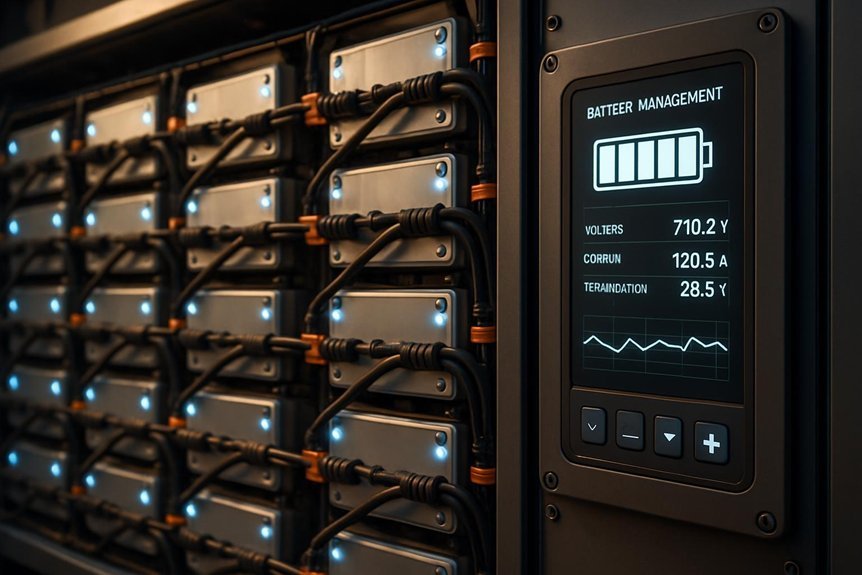
Although many components contribute to a power station’s efficiency, the Battery Management System (BMS) plays a critical role in ensuring peak battery performance and longevity. We rely on the BMS to optimize the battery lifecycle by effectively managing charge and discharge cycles within safe parameters. This system precisely monitors cell voltages, temperatures, and current flows to maintain balanced energy storage, preventing premature degradation. By regulating these variables, the BMS maximizes usable capacity and preserves the structural integrity of battery cells over time. It also facilitates efficient energy storage integration, ensuring the power station delivers consistent output while adapting to fluctuating demand. In sum, the BMS acts as the central coordinator, enabling us to sustain reliable performance and extend the operational lifespan of the battery arrays critical to the station’s functionality.
How a BMS Monitors and Protects Battery Health
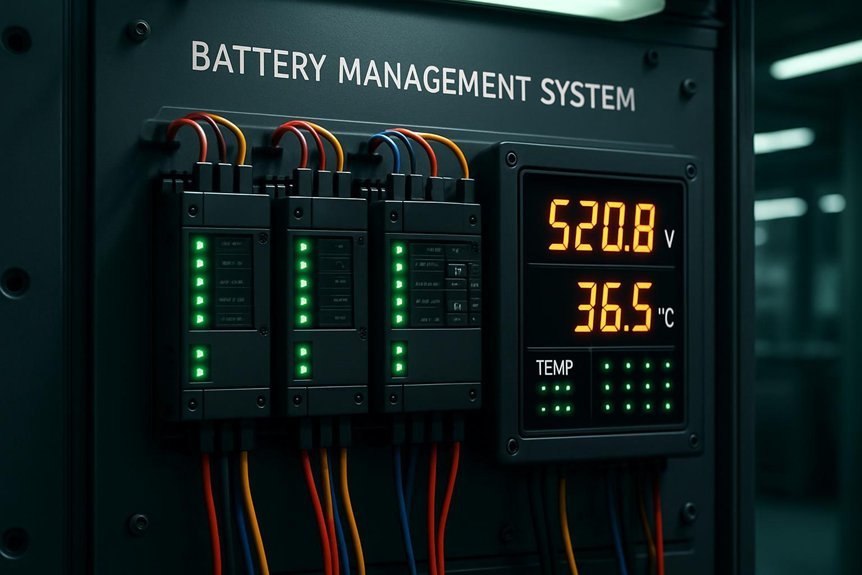
To maintain the ideal battery performance we rely on, the BMS continuously monitors key health indicators such as voltage, temperature, and current at the cell level. These monitoring techniques enable early detection of anomalies that could compromise battery health. The BMS uses real-time data to balance cells, prevent overcharging, and avoid overheating, thereby extending battery life and ensuring safety.
| Parameter | Monitoring Purpose |
|---|---|
| Voltage | Detects over/under-voltage |
| Temperature | Prevents thermal runaway |
| Current | Controls charge/discharge rates |
| State of Charge | Estimates remaining capacity |
| State of Health | Tracks degradation over time |
Key Components Inside a Power Station BMS
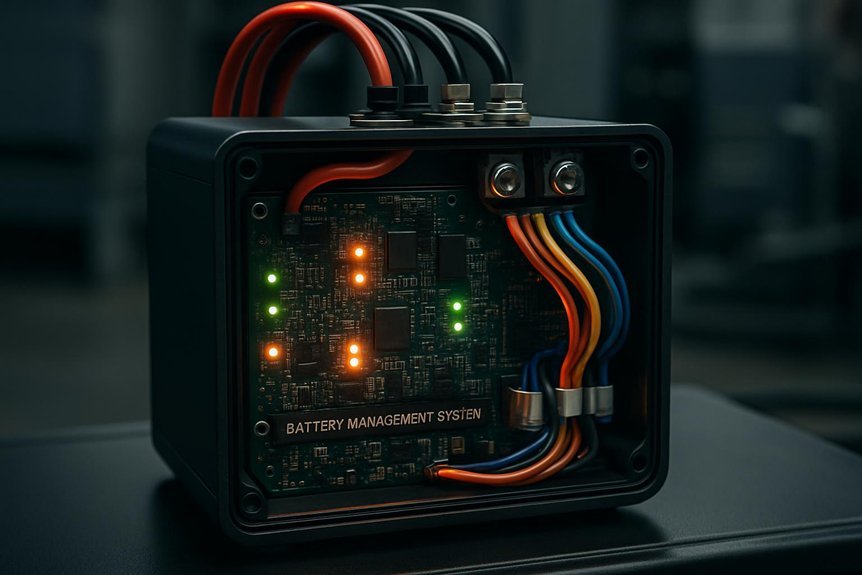
A power station’s Battery Management System comprises several critical components that work together to guarantee peak battery performance and safety. Understanding these elements helps us appreciate how energy storage remains reliable and secure.
- Battery Monitoring Unit (BMU): Continuously tracks voltage, current, and temperature, confirming cells operate within safe limits.
- Thermal Management System: Regulates battery temperature through cooling or heating mechanisms, preventing thermal runaway and optimizing efficiency.
- Control and Communication Module: Coordinates data flow between the BMU and external control systems, enabling real-time diagnostics and fault management.
Together, these components maintain battery integrity by balancing charge levels, managing thermal conditions, and facilitating precise control. This synergy confirms the energy storage system operates safely under varying load and environmental conditions.
How BMS Improves Energy Efficiency and Reliability
When we integrate a Battery Management System into a power station, it actively enhances both energy efficiency and operational reliability. The BMS continuously monitors battery parameters, enabling real-time energy optimization by balancing charge and discharge cycles. This reduces energy losses and extends battery life, contributing to reliability enhancement. Additionally, the BMS detects anomalies early, preventing failures and unplanned downtime.
| Feature | Benefit | Impact |
|---|---|---|
| Cell Voltage Control | Prevents overcharge | Improves battery lifespan |
| Temperature Monitoring | Avoids thermal stress | Guarantees system stability |
| State of Charge (SOC) | Optimizes energy usage | Maximizes power station output |
Through these functions, the BMS guarantees efficient energy use while maintaining system integrity, reinforcing both efficiency and reliability in power station operations.
Challenges and Future Trends for BMS in Power Stations
Although Battery Management Systems have greatly improved power station operations, we still face critical challenges that require innovative solutions. Addressing regulatory compliance while guaranteeing seamless system integration remains complex, especially as renewable integration grows. Cybersecurity measures must evolve to protect increasingly connected BMS architectures. Looking forward, we see three key areas for development:
- Enhancing data analytics and predictive maintenance to optimize performance and preempt failures.
- Overcoming scalability issues to support larger, more diverse energy storage systems.
- Expanding user training programs to guarantee proper operation and maintenance in complex environments.
Frequently Asked Questions
How Much Does a Battery Management System Cost for a Power Station?
We estimate the cost factors of a battery management system for a power station typically range from tens to hundreds of thousands of dollars. Installation expenses also vary widely, influenced by system size, complexity, and site-specific requirements.
Can a BMS Be Retrofitted Into Existing Power Stations?
Yes, we can retrofit a BMS into existing power stations, but BMS installation involves retrofit challenges like compatibility with legacy systems, space constraints, and integration complexity. Careful analysis guarantees seamless upgrades without disrupting operations.
What Brands Manufacture Battery Management Systems for Power Stations?
We focus on brands like Tesla, LG Chem, and ABB, leading in battery technology and system integration. They drive energy storage innovation, aligning with market trends and ensuring reliable, scalable Battery Management Systems for power stations.
How Often Does a BMS Need Maintenance or Software Updates?
We typically schedule BMS maintenance and software updates every 6 to 12 months to guarantee battery health and system reliability. Regular updates help prevent failures and optimize performance based on evolving operational data and diagnostics.
Are There Regulatory Standards for BMS in Power Stations?
We understand regulatory compliance acts as the compass guiding BMS design in power stations. We guarantee safety standards are met rigorously, analyzing protocols to maintain system integrity, preventing failures, and safeguarding both equipment and personnel effectively.
Conclusion
As we’ve seen, a Battery Management System in a power station acts like the conductor of a symphony, orchestrating each cell’s performance to achieve harmony in energy storage. By vigilantly monitoring and balancing, it safeguards battery health and boosts efficiency. Steering through challenges ahead, we’re reminded that mastering this technology is key to revealing a resilient, sustainable energy future—where power flows as seamlessly as the notes in a well-composed masterpiece.