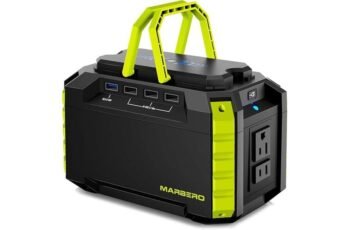
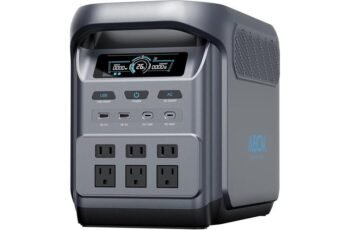
We’ll assess the HOWEASY Portable Power Station as a compact 260W backup, focusing on its 178Wh battery, ports, charging options, and practical limits. At five pounds, it’s easy to carry, but its capacity and output rule out many high-demand appliances. We’ll also consider its lighting and safety features to see where it fits best—and what you should check before relying on it away from home.
Key Takeaways
- The HOWEASY power station delivers 260W of continuous output, with a 500W peak for brief startup surges.
- Its 178Wh battery and nine outputs suit phones, laptops, cameras, and compatible CPAP machines, but limit runtime and appliance size.
- Charging options include solar, wall, and car power; solar charging depends on available sunlight.
- Compact at 5 pounds, it adds LED lighting, built-in safety protections, and a two-year warranty.
- Best for camping, travel, and short-term device charging—not high-demand appliances or household backup.
260W Power and 178Wh Battery
With 260W of running power and 500W peak output, the HOWEASY H260 can handle compatible low-wattage devices and brief startup surges. Its 178Wh battery capacity, rated at 48,000mAh, stores energy for portable use and short-duration backup. We can use the stated power output to assess whether a device’s operating demand falls within the unit’s limits; devices requiring more than 260W continuously aren’t suitable. The 500W peak rating supports brief startup demands, not sustained loads. Its 110V pure sine wave AC supply runs at 60Hz, providing standard household-style output for compatible equipment. Actual runtime varies with device consumption and operating conditions.
Detailed features
Beyond its 260W output and 178Wh capacity, the HOWEASY H260 offers nine ports: two AC outlets, one 65W USB-C PD port, three USB-A ports, and three DC ports. We can charge phones, laptops, cameras, and compatible CPAP machines.
| Feature | Specification |
|---|---|
| AC output | 110V pure sine wave, 60Hz |
| Charging | Solar, wall adapter, or car |
| Protection | Short circuit, overload, overheating |
| Portability design | 8.71 × 4.72 × 5.43 in; 5 lb |
| LED lighting | Low, high, and SOS modes |
A hidden handle supports carrying and storage. Separate AC/DC controls simplify operation. The package includes charging accessories and a manual.
Pros and Cons
We’ll weigh the H260’s compact design, versatile ports, and safety protections against its 260W running-power limit. This comparison will help you decide whether its capacity suits your devices and intended use. Let’s review the main pros and cons.
Pros
The HOWEASY H260’s main strengths are its versatile ports, compact design, and flexible charging options. We can power compatible devices through nine outputs, including 65W USB-C PD and pure sine wave AC. Its 178Wh battery supports varied portable needs.
| Advantage | Specification | Practical value |
|---|---|---|
| Port selection | Nine outputs | Charge several devices |
| Compact portability | 5 lb; hidden handle | Carry or store easily |
| Flexible charging | Solar, AC, car | Recharge in varied settings |
We also get emergency lighting with low, high, and SOS modes. Built-in protections help guard against electrical faults and overheating, while separate AC/DC controls simplify operation. The two-year warranty adds support.
Cons
Despite its portability and flexible ports, the H260 has limited capacity and output: its 178Wh battery and 260W running limit may not support larger appliances or extended use. We should treat it as a backup for smaller devices, not a substitute for household power. Limited runtime can restrict how long we run a CPAP machine, laptop, or several devices together, especially near the 500W peak ceiling. Recharging also requires an AC adapter, car charger, or compatible solar panel, so solar dependency may affect off-grid use when sunlight is inconsistent. Its compact size comes with clear power trade-offs for longer trips or demanding loads.
Concluding thoughts
Overall, we find the HOWEASY H260 a compact option for charging small devices and powering compatible equipment up to 260W. Its 178Wh battery, nine output ports, and pure sine wave AC outlets support a range of everyday electronics, while solar, wall, and car charging offer flexible replenishment. At five pounds, it’s easy to carry for camping convenience or keep in a vehicle for emergency readiness. However, its capacity and output limit it to smaller loads rather than high-demand appliances. We’d consider it for travel, backup lighting, and short device-charging needs, with built-in protections and a two-year warranty adding reassurance.
Frequently Asked Questions
What Comes Included With the HOWEASY H260 Power Station?
We get the H260 power station, an AC adapter, a car charger, and a user manual. These package contents cover basic setup and charging; included accessories don’t include a solar panel, which we must purchase separately.
How Long Is the H260 Covered by Its Warranty?
The H260’s warranty lasts two years—an eternity in portable-power terms. We can confirm the listed Warranty duration, but the manufacturer doesn’t specify Coverage terms here; you should contact its 24/7 customer service for details.
Can the H260 Be Recharged From a Car?
Yes, we can recharge the H260 from a car using the included car charger. For Car charging, connect it to your vehicle’s outlet; this Vehicle recharge option complements AC and compatible solar-panel charging.
Does the H260 Have a Built-In Flashlight?
Yes, the H260 includes a Built in flashlight with low- and high-brightness settings, plus SOS mode. We can use its separate flashlight controls to choose the flashlight brightness that suits your needs during travel or emergencies.
How Much Does the H260 Weigh?
The H260 weighs 5 pounds—light enough for a modest Atlas. For our Portability assessment, its Weight specifications pair that compact heft with a hidden handle, making it easy for you to carry in a backpack or vehicle.
Conclusion
The HOWEASY portable power station is a compact backup, not a whole-home solution. Its 178Wh battery and 260W continuous output can keep phones, laptops, cameras, and compatible CPAP machines running, while the 500W peak supports brief startup surges. Nine outputs, including 65W USB-C, add flexibility, and solar, wall, or car charging suit different trips. At five pounds, it travels easily. Think of it as a small safety net: useful for essentials, but limited by runtime and sunlight. Avoid high-demand appliances.