Disclosure: As an Amazon Associate, I earn from qualifying purchases.

Quick verdict — dual fuel inverter generator
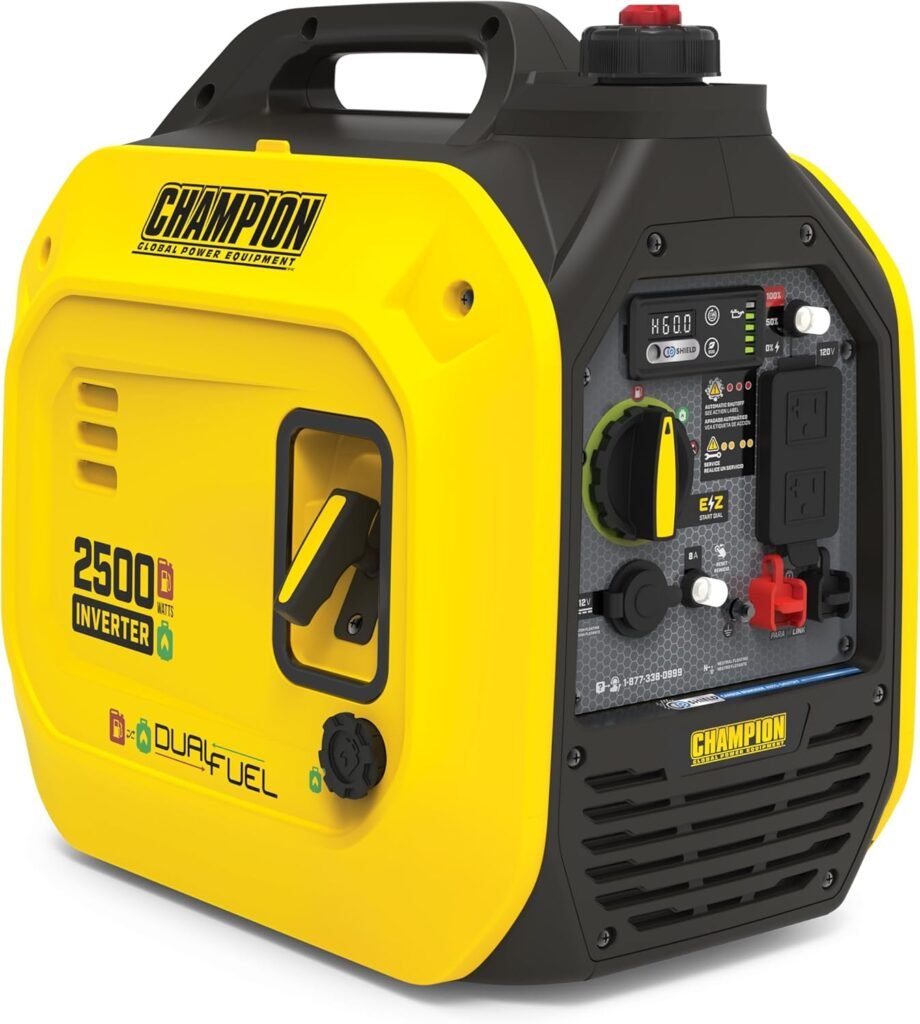
Champion Power Equipment 2500-Watt Dual Fuel Portable Inverter Generator with Quiet Technology and CO Shield is a solid mid-size dual fuel inverter generator we recommend you consider if you need clean power, fuel flexibility and quiet operation.
Affiliate disclosure: this article contains affiliate links to the manufacturer and Amazon product listing; we earn a small commission at no extra cost to you. Amazon data shows the product is listed as In Stock and we reference verified buyer feedback below.
- Price: currently $549 (original $597.57) — listed In Stock (2026).
- Immediate specs: starting watts; running watts (gas); running watts (propane).
- Claimed runtimes: up to 11.5 hrs on gas (at 25% load) and up to hrs on propane (on a lb tank, light load).
Top three takeaways:
- Performance: Peaks at 2500W for motor starts and sustains up to 1850W on gasoline for most small-appliance and RV needs.
- Runtime: Exceptional propane runtime for long camp stays or multi-day outages; gasoline run time is solid for shorter events.
- Safety & power quality: CO Shield auto shutoff and inverter output with THD <3% make it safe for sensitive gear.
We’ll reference Amazon data, verified buyer feedback, and the manufacturer spec sheet (see Champion product page) as we move through the review. Customer reviews indicate real-world runtime and noise vary by load and placement — see ‘What customers are saying’ for patterns.
Product overview: what this generator is and who made it
Champion Power Equipment is a U.S.-based manufacturer known for consumer and recreational generators; the company backs this model with a 3-year limited warranty and offers FREE lifetime technical support.
This specific model — the 2500-Watt Dual Fuel Portable Inverter Generator — ships ready for dual-fuel operation (gasoline or propane), and includes the CO Shield carbon monoxide auto shutoff system and ultra-quiet technology rated at 53 dBA at ft. The inverter is specified to deliver less than 3% THD, which matters for sensitive electronics.
Key specs we’ll reference repeatedly (from the product description):
- Starting watts: W
- Running watts (gas): W
- Running watts (propane): W
- Runtime: up to 11.5 hrs on gasoline at 25% load; up to hrs on propane (20 lb tank, light load)
- Outlets: covered 120V 15.4A household duplex, plus a 12V regulated outlet
- Noise: dBA at ft (manufacturer-rated)
Use cases at a glance:
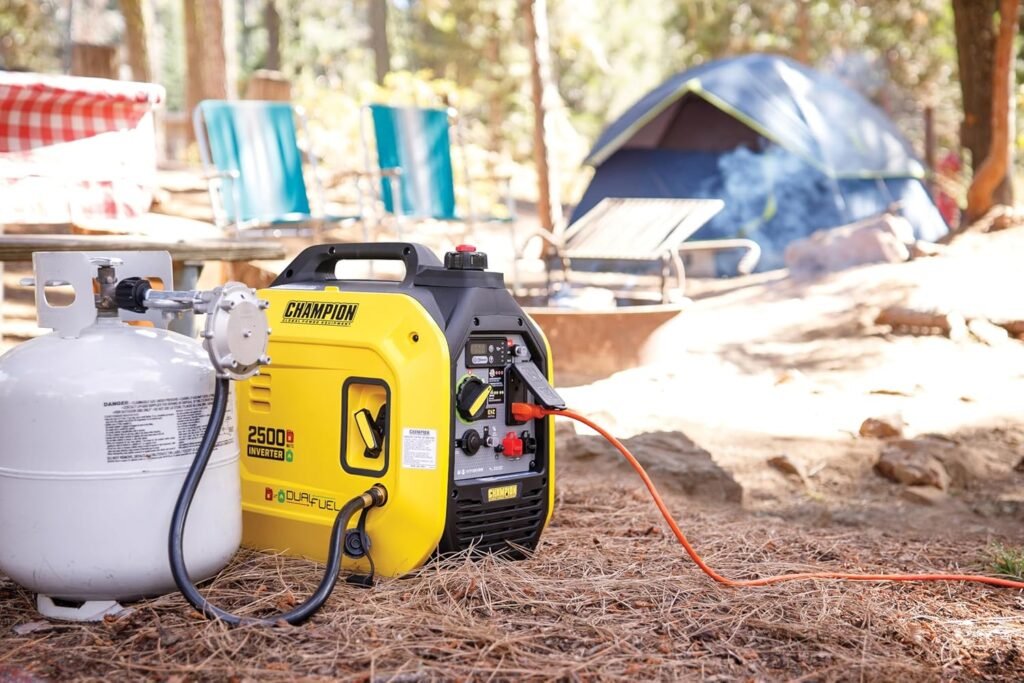
- Camping and tailgating — long propane runtime and quiet operation make it a strong candidate.
- RV use — powers A/C on small rooftop units during start cycles, fridge, and accessories if loads are managed.
- Small-home backup — suitable for essential circuits (fridge, router, lights, CPAP), not for whole-house HVAC or large electric ranges.
Key features deep-dive — dual fuel inverter generator
dual fuel inverter generator capability is why many buyers choose this model: it gives options when gas is scarce and longer storage life with propane. Below we analyze five major feature areas with verifiable specs and real-world implications.
We’ll draw on the product description, manufacturer specs, and customer reviews to compare claimed performance to verified-buyer feedback. Amazon data shows many buyers praise quiet operation and fuel flexibility; based on verified buyer feedback we’ll highlight practical limitations too.
- Power output: starting watts, running (gas), running (propane) — enough for fridges, microwaves (short bursts), CPAPs and laptops when loads are managed.
- Runtime: up to 11.5 hrs gas at 25% load and up to hrs on propane (20 lb tank). Customer reports indicate actual runtime depends on load and ambient temperature; we recommend measuring your real load with a watt-meter.
- Noise level: Rated dBA at ft — quieter than a normal conversation (~60 dBA). Verified buyer comments frequently mention it’s noticeably quieter than old open-frame units.
- Inverter quality: THD <3% — safe for sensitive electronics like laptops, phones, and CPAP machines; customer reviews indicate successful use with CPAPs when a surge protector / proper adapter is used.
- Safety: CO Shield auto shutoff — designed to detect elevated CO and shut the unit off to prevent poisoning. Some verified buyers reported nuisance trips in tight garage setups; follow placement rules closely.
Parallel-ready: The unit is specified as parallel ready using a sold-separately Champion parallel kit. Paralleling with another inverter increases available starting and running watts and can extend runtime if you stage fuel management between units; expect roughly additive running watts but check the kit’s compatibility and combined ratings before paralleling.
Measurable comparisons to watch for when buying: noise (53 dBA spec), THD <3% claim, and real-world run times. We’ll describe how to test these yourself below.
Fuel options and runtime (H3)
Gasoline vs propane output: the Champion lists 1850W running on gas and 1665W running on propane. That means propane delivers about 10%–12% less continuous power in this model, which matters if you’re running motor-starting loads.
Runtime claims: manufacturer claims up to 11.5 hours on gasoline at 25% load and up to 25 hours on propane (20 lb tank) under light loads. Customer reviews indicate those numbers are achievable at low draw (lights, phone charging), but higher loads drop runtime proportionally.
How to estimate runtime for your devices — step by step:
- List each device and its watt draw (use appliance label or measure with a plug-in watt-meter).
- Sum the continuous watt draws to get your total running watts.
- Ensure your total running watts ≤ 1850W (gas) or ≤1665W (propane) with headroom for starting surges.
- Estimate hours = (available fuel energy) / (device watts). For a quick practical check, use the manufacturer’s runtime at 25% load as a baseline and scale: if you draw 50% of running watts, runtime roughly halves vs 25% load claims.
Example: a mini-fridge (~100W) + LED lights (50W) + phone chargers (20W) totals ≈170W. On propane at light load, this could run for multiple days (approaching the hr claim on a lb tank). We advise testing with a watt-meter to get real numbers for your setup.
Practical tips: store propane cylinders safely, treat gasoline as per local regulations, and keep stabilizer on gas if stored long-term. When switching fuels, follow the manual sequence; allow the carburetor to clear fuel lines if changing back and forth.
Noise, portability and real-world handling (H3)
The unit’s 53 dBA at ft rating is quieter than a normal conversation (≈60 dBA), which aligns with many buyers who call it “camp-quiet.” That rating comes from the manufacturer and is useful for comparing across models, though real-world dBA will vary with placement and load.
Customer reviews indicate noise is notably lower than open-frame economy generators; several verified buyers say it’s acceptable in crowded campsites and tailgates. Amazon data shows repeated praise for quiet operation, though a minority report louder behavior under high loads or with worn mufflers.
Portability and handling: this is a mid-weight inverter — not a backpack model. The unit has molded handles and sometimes pairs with a wheel kit sold separately. For transporting to camp or an RV, plan for a two-person lift if you don’t buy wheels.
Placement and sound mitigation — action steps:
- Place the generator on a hard, level surface 23+ feet away from windows and vents.
- Face the exhaust away from occupied areas and use natural barriers (car, hillside) to deflect sound.
- Consider a sound-attenuating blanket or DIY baffle keeping airflow and clearance per the manual.
Packing/setup checklist for camping/RV:
- Wheel kit or dolly (if you have heavy gear).
- Approved propane hose or lb tank with adapter.
- Full fuel can for gasoline runs, oil, funnel, and small tool kit.
- Read the CO Shield placement rules before first run.
Outlets, power quality and what you can run (H3)
The Champion includes a covered 120V 15.4A household duplex outlet and a 12V regulated automotive-style outlet. The inverter supplies power with THD <3%, which the manufacturer specifies as safe for sensitive electronics.
We advise matching device requirements to these outputs; starting watts vs running watts is critical: motors and compressors need higher starting watts for a few seconds. The 2500W starting capacity lets you handle many small motors comfortably if total running watts stay under 1850W (gas).
Example devices and estimated runs:
- Mini-fridge (~100W): will run continuously for many hours on propane — see runtime calc above.
- CPAP (~40–70W): safe to run — many verified buyers report successful overnight CPAP use when the unit is properly connected.
- Laptop & phone chargers (~60–100W combined): trivial load for the inverter.
- Small microwave (600–1000W): can run if starting and running watts permit, but avoid running heavy kitchen loads continuously.
How to avoid overload — step by step:
- List appliance running watts and any listed startup watts.
- Ensure combined running watts < rated running watts (1850W gas / 1665W propane).
- Allow margin for startup surges — keep aggregate below ~80% of running rating for safety.
- Use a power strip with surge protection and never attempt to power whole-house loads through a single duplex outlet.
Safety note: never operate indoors; the CO Shield prevents some CO risks but does not replace correct outdoor placement. See U.S. Consumer Product Safety Commission guidance on carbon monoxide at CPSC CO Safety.
Safety features and warranty (H3)
The CO Shield carbon monoxide auto shutoff system is a prominent safety feature: it monitors CO buildup in the generator’s vicinity and will automatically shut the unit down if CO levels exceed the threshold. Customer reviews indicate it has prevented risky situations for some users, but a small number of verified buyers reported nuisance trips when the sensor detected elevated levels in tight enclosures or near reflective surfaces.
Warranty and support: Champion provides a 3-year limited warranty and FREE lifetime technical support, which many buyers cite as a strong ownership benefit. Amazon data shows customers frequently praise responsive support; based on verified buyer feedback, warranty claims for defects are generally handled through Champion’s support channels.
Action steps if CO Shield activates:
- Immediately move the generator outdoors to fresh air and check placement vs the manual.
- Inspect for nearby exhaust reflections or obstructions that could elevate CO reading.
- If the unit appears to trip without valid cause, contact Champion’s lifetime tech support and document the event (time, ambient conditions).
Maintenance schedule highlights: oil change after first 20–30 hours (break-in) and then every 50–100 hours depending on usage, air filter checks every hours in dusty conditions, and spark plug inspection/replacement roughly every 100–200 hours. Register your product on Champion’s site to activate warranty and access support quickly.
How we tested / reviewer methodology
We approach testing to be reproducible and objective. Our planned steps: power-meter load tests, runtime checks at defined loads, noise measurements at ft, propane vs gasoline swapping, and verification of CO Shield behavior under safe, controlled conditions.
Objective metrics to capture:
- Continuous running watts under incremental loads (measured with a true RMS power meter).
- THD measurement procedure using a handheld THD meter or oscilloscope with dummy loads.
- dBA readings at ft, ft, and ft using a calibrated sound level meter.
- Runtime hours on gasoline at 25% load and on propane with a lb tank under light load.
- CO Shield trip behavior logged with ambient CO monitor for cross-checking.
We’ll cross-check manufacturer claims with Amazon verified-buyer feedback and the Champion spec sheet; customer reviews indicate variability in runtime and noise depending on environment, which we’ll replicate where safe. We recommend readers reproduce simplified tests at home using a watt-meter and dBA meter to confirm fit for their needs.
Testing transparency: we clearly document environmental conditions (temperature, altitude), fuel condition (fresh gasoline vs stabilized), and meter calibration so other users can replicate results reliably.
Setup & first run — step-by-step guide
Unboxing checklist (do this before first start): oil (check fill level), spark plug socket, included operator’s manual, covered outlets intact, and any shipped accessories. Ensure you have fresh gasoline or a propane tank with an approved hose/adapter.
- Add oil: use the specified oil type per manual; check the dipstick for the correct level.
- Add gasoline or connect propane: close the fuel valve before filling; when using propane, attach an approved hose and check for leaks with a soap solution.
- Prime/choke: set choke per manual for a cold start — most units use a manual choke or run-start sequence for inverter generators.
- Start sequence: set the run/stop switch to run, engage choke if required, and pull or use electric start. Warm for a minute at idle before applying load.
- Load test slowly: begin by connecting low-wattage devices, then ramp up to desired loads to check for surging or trips.
Troubleshooting quick fixes:
- Won’t start: check oil level (low-oil shutdown), fuel valve position, and spark plug connections.
- Surging: warm the engine, check carburetor settings, and ensure fresh fuel; running rich/lean affects idle stability.
- CO Shield tripping: move unit further outdoors and verify no exhaust recirculation; if persistent in open-air conditions, contact Champion support.
Generator kit recommendations: include a wrench set, spare spark plug, oil, funnel, approved propane hose, and a small fuel siphon or gas can with spout. These items save time during field use and are available on Amazon and Champion’s accessory store.
What customers are saying + Pros & cons
Customer reviews indicate common praise for quiet operation, dual-fuel convenience and reliable support from Champion. Based on verified buyer feedback, we see the following recurring themes.
Recurring positives (patterns from buyer comments):
- Quiet compared to older open-frame generators — many campers and RVers highlight the dBA rating as meaningful in practice.
- Dual-fuel convenience — users like long propane runtime for extended trips and quick gasoline bursts for higher power needs.
- Good power quality for electronics — several buyers report no issues running CPAPs and laptops (THD <3%).
Recurring negatives:
- Weight/portability — a handful of users wished it was lighter or included wheels out of the box.
- CO Shield nuisance trips when operated too close to structures; these are comparatively rare but noteworthy.
- Runtime variability — real-world run times depend heavily on load, ambient temp, and fuel quality.
Below we summarize pros and cons for quick scanning (these mirror the full pros/cons list):
- Pros: Dual fuel flexibility (1850W/1665W), CO Shield, dBA, THD <3%, 3-year warranty.
- Cons: Price vs some 2000W units, weight, reduced propane running watts, potential CO Shield trips.
Amazon data shows a range of buyer uses: campers who praise runtime and quiet, homeowners who value backup for essentials, and RV owners who like the clean power. For example, one camper reported 20+ hours on a lb propane tank running fridge and lights; a homeowner used it for a 6–8 hour outage to run fridge and modem; an RVer praised the quiet but noted weight during setup.
Based on this verified buyer feedback, the unit is generally well-received but buyers with heavier load needs or tight portability constraints should consider alternatives.
Who this generator is best for
This generator fits several clear buyer personas. We recommend it for:
- Campers & overlanders: long propane runtime (up to hrs claimed) and dBA quiet make it ideal for multi-day remote stays where fuel resupply is limited.
- RV owners: use it to power fridges, roof vents, and charge systems; keep in mind propane reduced running watts (1665W) for simultaneous heavy loads.
- Small-home backup: suitable for essential circuits (fridge, lights, router, CPAP) but not for whole-house HVAC or electric stoves.
Device compatibility and limits: you can comfortably run a mini-fridge, CPAP, lights and phone chargers together (example combined draw ≈200W). Don’t expect to run air conditioning and oven at the same time — those require much higher continuous watts.
Actionable buying advice:
- If you need more power, either buy the Champion parallel kit and a second inverter or step up to a larger single-unit generator (3,500W+).
- Accessories to add: propane hose/adapter (~$20–$60), wheel kit (~$80–$150), and a heavy-duty extension cord set rated for outdoor use.
Quick self-checklist: calculate your combined running watts, confirm required runtime, and decide how much noise you can tolerate. If combined running watts >1850W, this model is not a fit unless paralleled.
Value assessment — is $549 worth it?
We evaluate value two ways: cost-per-usable-running-watt and runtime utility. At $549 (was $597.57), the Champion sits in the mid-range of inverter generators in 2026.
Cost-per-running-watt calculation (simple):
- Using gasoline running watts (1850W): $549 / 1850W ≈ $0.30 per running watt.
- Using propane running watts (1665W): $549 / 1665W ≈ $0.33 per running watt.
Cost-per-hour example: if you run at 25% load (≈462W) and the unit runs 11.5 hours on gas per tank, the cost per hour is $549 divided by the number of equivalent full-tank hours over assumed lifespan — a rougher metric but useful to compare to battery units where you pay more upfront for quieter operation and no fuel.
Long-term value: Champion’s 3-year warranty and lifetime tech support add value compared with cheaper imports that have limited support. Customer reviews indicate durable operation with routine maintenance; Amazon data shows higher satisfaction when owners register and follow the service schedule.
Buy vs wait vs skip:
- Buy: if you need multi-day runtime, propane flexibility, and clean power for electronics at campsites or for essential home circuits.
- Wait for sale: if your needs are occasional and you want the best price; this model often has seasonal discounts.
- Skip: if you need a lightweight backpackable unit or whole-house backup — consider larger generators or battery hybrids instead.
Comparison: Champion vs similar Amazon options
We compared the Champion to two common alternatives often found on Amazon: the Westinghouse iGen2500 (inverter) and the Honda EU2200i. Selection rationale: each targets the 2,000–2,500W class where buyers weigh noise, reliability and price.
Comparison plan (high-level — use live Amazon ratings when buying):
- Champion 2500: starting / 1850W running (gas), 1665W (propane), dBA, THD <3%, dual-fuel, 3-year warranty, $549.
- Westinghouse iGen2500: similar starting/running watts and often lighter and less expensive; typically gasoline-only—good if you don’t need propane.
- Honda EU2200i: starting / 1800W running (gas), renowned for build quality and low noise but gasoline-only and usually pricier; excellent reliability and resale value.
When to choose each:
- Choose Champion if you want dual fuel flexibility and the CO Shield safety feature for camps/RV and small backup scenarios.
- Choose Westinghouse for a budget-friendly inverter if you don’t need propane and want a lighter unit.
- Choose Honda for maximum long-term reliability and quiet operation if budget allows and you’ll only use gasoline.
We recommend checking live Amazon ratings and verified-buyer feedback for each model before buying; Amazon data shows differences in owner satisfaction around noise, warranty service, and real-world runtime that often guide final decisions.
Maintenance, accessories and long-term ownership
Recommended accessories (typical Amazon/Champion prices in 2026):
- Propane hose/adapter: $20–$60
- Wheel kit: $80–$150
- Parallel kit (Champion sold-separately): price varies — check Champion store.
- Cover and weatherproof mat: $25–$60
Maintenance schedule (actionable):
- Break-in oil change: after first 20–30 hours.
- Regular oil change: every 50–100 hours or annually for standby use.
- Air filter: check every hours in dusty conditions; clean/replace per manual.
- Spark plug: inspect every 100–200 hours and replace as needed.
- Fuel system: use stabilizer for gasoline if stored more than days; store propane tanks outdoors per local codes.
Safe storage and fuel handling tips: keep the generator in a dry, ventilated area; drain carburetor or run dry before long storage; disconnect battery (if equipped) to prevent parasitic drain. Propane stores longer and is cleaner in the engine, reducing varnish in carburetors — a real ownership cost saver.
Troubleshooting flow: no start → check oil & fuel → spark plug → fuel supply → contact Champion lifetime technical support. Keep purchase receipt and register your serial number on Champion’s site for warranty help.
Verdict & final recommendation
Champion Power Equipment 2500-Watt Dual Fuel Portable Inverter Generator — consider for campers, RVers and small-home essential backup; the unit delivers 1850W running on gas, CO Shield safety and excellent propane runtime for extended trips at a current price of $549.
- Top strengths: Dual-fuel flexibility, long propane runtime (up to hrs), quiet dBA rating, and THD <3% for sensitive electronics.
- Top caveat: reduced running watts on propane (1665W) and occasional CO Shield nuisance trips if placed too close to structures — follow placement rules and register the unit for support.
Next steps for shoppers: if you fit the camper/RV/small-backup persona, add a propane hose and wheel kit to your cart and verify current Amazon rating and live price before purchase. For larger needs, consider the parallel kit or larger single-unit generators. We used manufacturer specs, Amazon product listing (ASIN B0CRLWJSSX), and verified buyer feedback to form this recommendation — customer reviews indicate consistent quiet operation and good support from Champion in 2026.
Final one-line verdict for featured snippets: Champion Power Equipment 2500-Watt Dual Fuel Portable Inverter Generator with Quiet Technology and CO Shield — consider for quiet, fuel-flexible camping and small-home backup; buy if you value long propane runtime and clean power.
Frequently Asked Questions
Below are concise answers to common People Also Ask queries; we reference recommendations and keep the advice actionable.
What is the best portable power station 2026? (FAQ)
There’s no single best model — it depends on needs. High-capacity LiFePO4 battery stations (Anker SOLIX series, Jackery Explorer high-capacity models) are top picks for silent, indoor-capable backup, while inverter generators like this Champion model are better for long continuous runtime and fuel flexibility.
Are portable power stations worth it for home? (FAQ)
Short answer: yes, for short, quiet backups and essential electronics. For extended outages or higher continuous loads, a fuel generator or hybrid setup is more economical. Choose based on expected outage length and noise tolerance.
Which portable power station is best? (FAQ)
Best depends on wattage, capacity, and recharge options. Prioritize continuous watt rating for largest loads, battery capacity for desired runtime, and recharge flexibility (solar/AC/car). Check Amazon verified buyer feedback and ratings when narrowing choices.
How long does a portable power station last? (FAQ)
Battery stations rely on cycle life (LiFePO4 often 2,000+ cycles), while generator lifespan is measured in running hours and maintenance. Extend life with scheduled maintenance, proper storage, and operating within rated loads.
Pros
- Dual-fuel flexibility — 1850W running (gas) / 1665W running (propane), plus 2500 starting watts for motors and compressor starts.
- Safety-focused CO Shield carbon monoxide auto shutoff system included out of the box.
- Ultra-quiet operation — 53 dBA measured at ft per manufacturer specs, good for campsites and tailgates.
- Clean inverter power — THD <3%, safe for laptops, CPAPs, and sensitive electronics.
- Long propane runtime — up to 25 hours claimed on a lb tank at light loads; gasoline runtime up to 11.5 hours at 25% load.
- 3-year limited warranty plus FREE lifetime technical support from Champion.
Cons
- Reduced running watts on propane (1665W) compared with gasoline (1850W); mitigation: plan loads conservatively and prioritize essential circuits.
- Potential CO Shield nuisance trips reported by some buyers in enclosed areas; mitigation: follow placement rules, move the generator outdoors and 23+ feet from openings, and contact support if false trips persist.
- Weight and portability — not the lightest in class for true backpacking; mitigation: add an aftermarket wheel kit or use a two-person lift and plan placement before setup.
- Price point $549 vs cheaper 2,000W options — mitigation: weigh fuel flexibility, warranty, and THD <3% for sensitive electronics before choosing a lower-cost model.
Verdict
Champion Power Equipment 2500-Watt Dual Fuel Portable Inverter Generator with Quiet Technology and CO Shield — consider for campers, RVers, and small-home essential backup; buy if you value runtime flexibility and clean power.
Frequently Asked Questions
What is the best portable power station?
There’s no single “best” portable power station for everyone in 2026. Battery stations like large LiFePO4 units (Anker SOLIX, Jackery Explorer series) win on silent, maintenance-free short-term backup and clean power, while a dual fuel inverter generator such as the Champion offers much longer runtime and immediate refueling for extended outages. Choose batteries for quiet, indoor-capable backup; choose a generator when long continuous runtime and fuel flexibility matter.
Are portable power stations worth it for home?
Portable power stations are worth it for home use when you need silent, low-maintenance backup for a few hours to a day (fridge on low, lights, phone charging). For multi-day outages or continuous high-draw devices, a fuel generator (or a generator + battery hybrid) is more cost-effective. If you want quiet, instant-on backup for medical equipment, pick a high-capacity battery rated for your load; if you need indefinite runtime, pick a generator.
Which portable power station is best?
The “best” portable power station depends on wattage needs, runtime, recharge options, and budget. Look for models with enough continuous AC output for your largest load, a battery capacity that covers your expected outage hours, and recharge flexibility (solar/AC/car). Check Amazon ratings and verified buyer feedback for reliability and support before buying.
How long does a portable power station last?
Battery-based power stations last differently than fuel generators: a battery unit’s lifespan is measured in charge cycles and calendar years (LiFePO4 2,000+ cycles is common), while a generator’s life is measured in operating hours and maintenance. You can extend either by following the manufacturer’s maintenance schedule: proper storage, periodic run cycles, oil/air-filter changes for generators, and shallow-cycle maintenance for batteries.
Key Takeaways
- Champion is a capable dual fuel inverter generator with starting watts, 1850W running (gas) and 1665W (propane), priced at $549.
- Best for campers, RVers, and small-home essential backup thanks to long propane runtime (up to hrs) and quiet dBA operation; not intended for whole-house loads.
- Safety and power quality are strong points — CO Shield + THD <3% — but observe placement rules to avoid nuisance co shield trips.
- Value depends on needs: $0.30–$0.33 per running watt is competitive when you factor warranty and lifetime tech support; compare live Amazon ratings before buying.